Black Friday 2026: plan first, compare second, and check the "was" price
Black Friday is on 27 November - a TV "was R12 999, now R7 999" that sold for R8 499 all spring saves you R500, not R5 000, and R5 000 put on a card at 20% costs about R1 130 extra if you pay R250 a month.
In 30 seconds
- Write the list before 27 November - a shopping list with a price ceiling per item is what stops a "deal" from becoming spending you had not planned.
- A "was R12 999, now R7 999" TV that sold for R8 499 all spring saves R500, not R5 000 - the saving that counts is against the price you could actually have paid.
- R5 000 put on a card at 20% a year, paid off at R250 a month, costs about R1 130 in interest - enough to wipe out most of a 20% discount.
The deal is not the starting point
Black Friday falls on Friday 27 November 2026, and many stores start their "Black Friday" prices days earlier. By the weekend the question most people are asking is "what is on sale?" That is the wrong first question.
The right one is "what do I need before January, and what is the most I will pay for it?" A discount on something you were going to buy anyway is a saving. A discount on something you only noticed because it was discounted is spending.
Step 1: plan - a list with a ceiling on every line
Before you open a single sale page, write down three things for each item:
- What it is, specifically enough to compare - "a 55-inch 4K TV", not "a new TV".
- Why you need it now - a replacement, a gift you have already committed to, school things for January.
- Your ceiling - the most you will pay, decided now, while nobody is counting down a timer at you.
Then add up the ceilings. That total is your Black Friday budget, and it has to come out of money you already have, not next month's salary. If the total is more than you can pay in cash, the list is too long - cut it now rather than at the till.
Step 2: compare - same item, more than one price
The same product is often on sale at several stores at once, at different prices. Comparing them is tedious one shop at a time, which is why a deal aggregator helps.
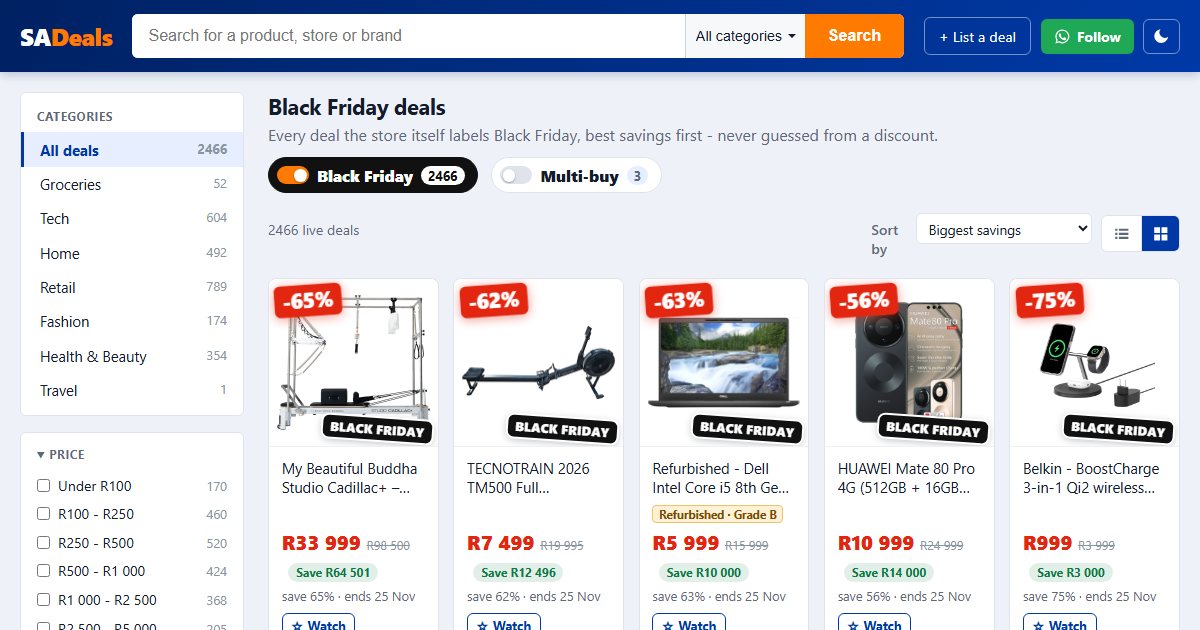
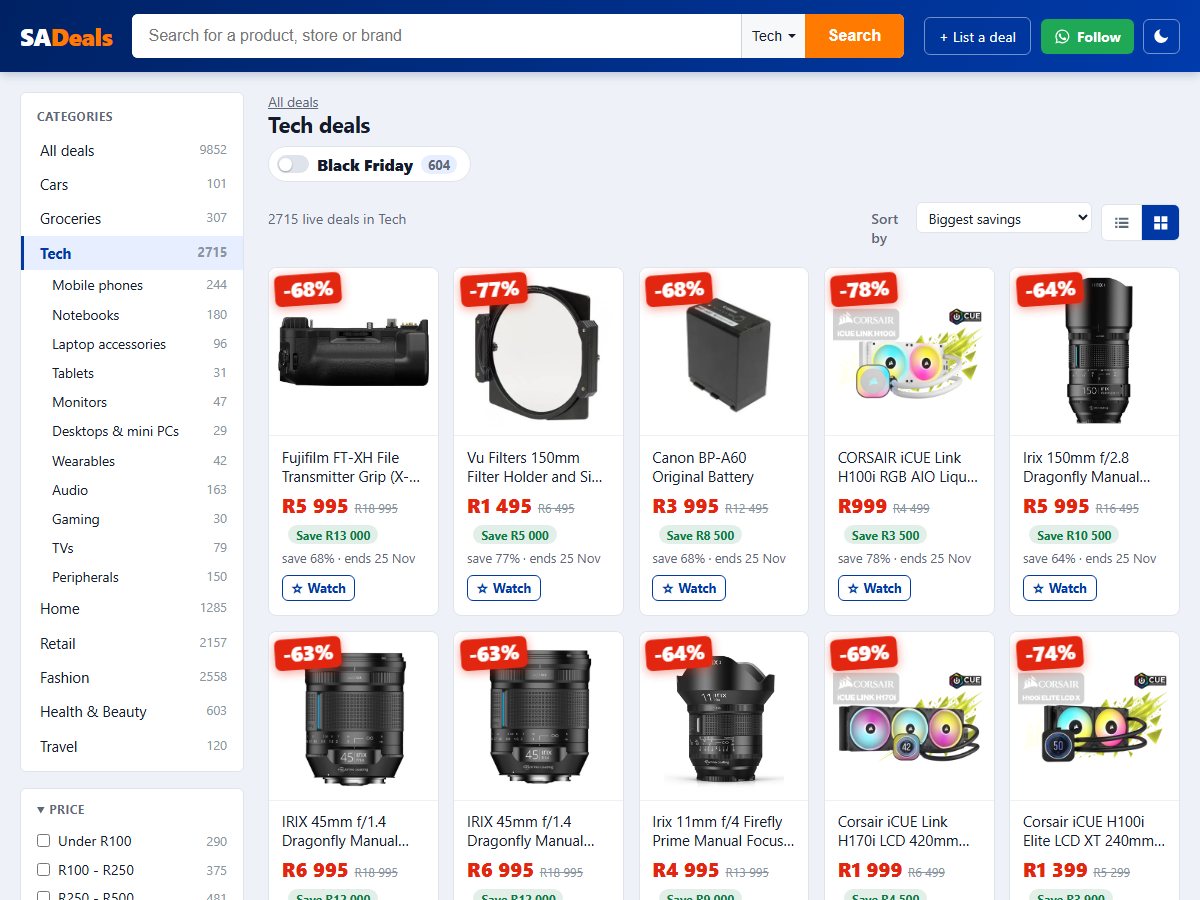
sadeals.co.za/black-friday lists only what the store itself labels as Black Friday - 2 466 live deals when we looked on 18 November - with the original price, the sale price, the Rand saving and the date the deal ends on every card. You can sort by biggest saving and narrow it down by category and price band.
A practical way to use it with your list:
- Search for the exact model from your list, not the category - a "55-inch TV" search mixes very different products.
- Tick the price band that matches your ceiling, so anything you cannot afford never shows up.
- Use Watch on items you are waiting for, so you are not checking prices every hour.
- Note the end date on the card - many deals end before or just after Black Friday itself.
Step 3: check the "was" price
A discount is only as honest as the "was" price it is measured from. A product shown as "was R12 999, now R7 999" looks like a R5 000 saving. If it actually sold for R8 499 for the three months before Black Friday, the real saving is R500 - the R12 999 was a price nobody paid.
Three quick checks before you buy:
- Has it been this price before? If you saw it at or near the sale price in October, the "deal" is the normal price.
- Is the saving suspiciously round? A 50% or 70% saving on a current-model phone or TV is worth a second look.
- Is it the same model? Black Friday stock is sometimes a cheaper variant - less storage, an older year - sold next to the full price of the better one.
The Consumer Protection Act prohibits false or misleading representations about price, including that a price is a saving when it is not (Consumer Protection Act 68 of 2008, section 41). That gives you grounds to complain - it does not stop it happening, so check anyway.
Step 4: pay in a way that keeps the saving
The cheapest price can still be the expensive purchase if it goes on credit you do not settle. Take R5 000 put on a credit card at 20% a year, paid off at R250 a month:
- It takes about 25 months to clear.
- You pay about R6 130 in total - roughly R1 130 in interest.
That interest is most of the R1 000 you would have saved with a 20% discount on the same R5 000. If a Black Friday purchase cannot be paid for in cash, or settled in full within the card's interest-free period, the discount is mostly an illusion.
The 20% a year is an illustrative rate, not the rate on any particular card. Use the rate on your own statement; the higher it is, the faster interest eats the discount.
A short checklist for 27 November
- List written, with a ceiling on every line and a total you can pay in cash.
- Each item searched on more than one store, or on a deal aggregator.
- "Was" price sanity-checked against what you have seen it sell for.
- Paid in cash, or on a card you settle in full this month.
- Anything not on the list waits until January - most of it will be on sale again.
How MaxWealth helps
If some of this year's shopping is going on a card or store account, the debt payoff planner takes your own balances, rates and monthly payments and shows how long each will take to clear and what it costs in interest - and how much sooner it ends if you pay a little more.
Sources
- Consumer Protection Act 68 of 2008 - section 41, false, misleading or deceptive representations.
- sadeals.co.za Black Friday deals - live deal count as displayed on 18 November 2026.
- Credit card example: MaxWealth calculation, R5 000 at 20% a year compounded monthly, R250 a month.
Education, not financial advice. This post explains how the rules and the arithmetic work. It does not recommend any financial product, and your own situation may differ - speak to a registered financial adviser or tax practitioner before you act. Figures were checked against the linked sources on the date above.