Debt consolidation: when one loan saves money, and when it just stretches the term
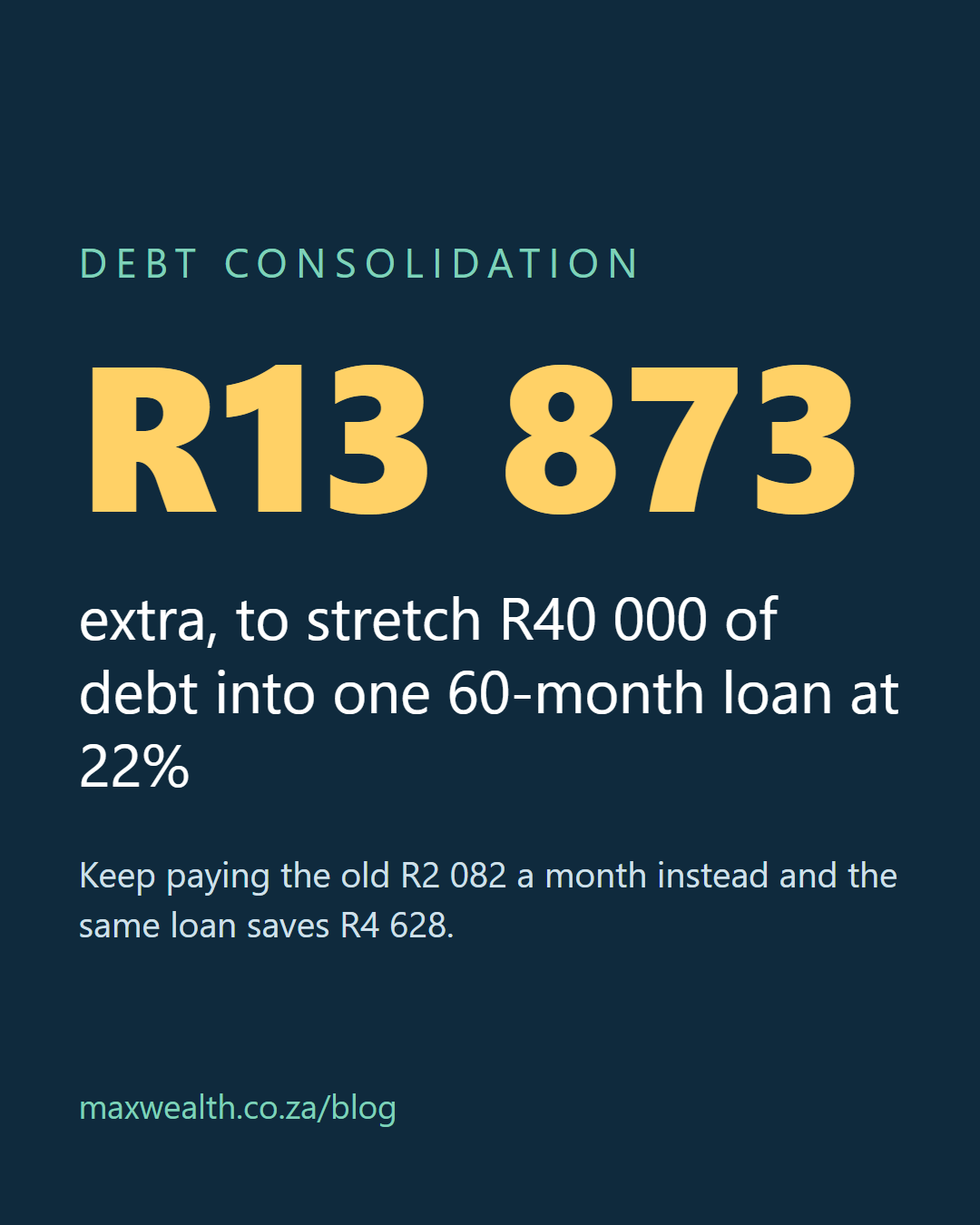
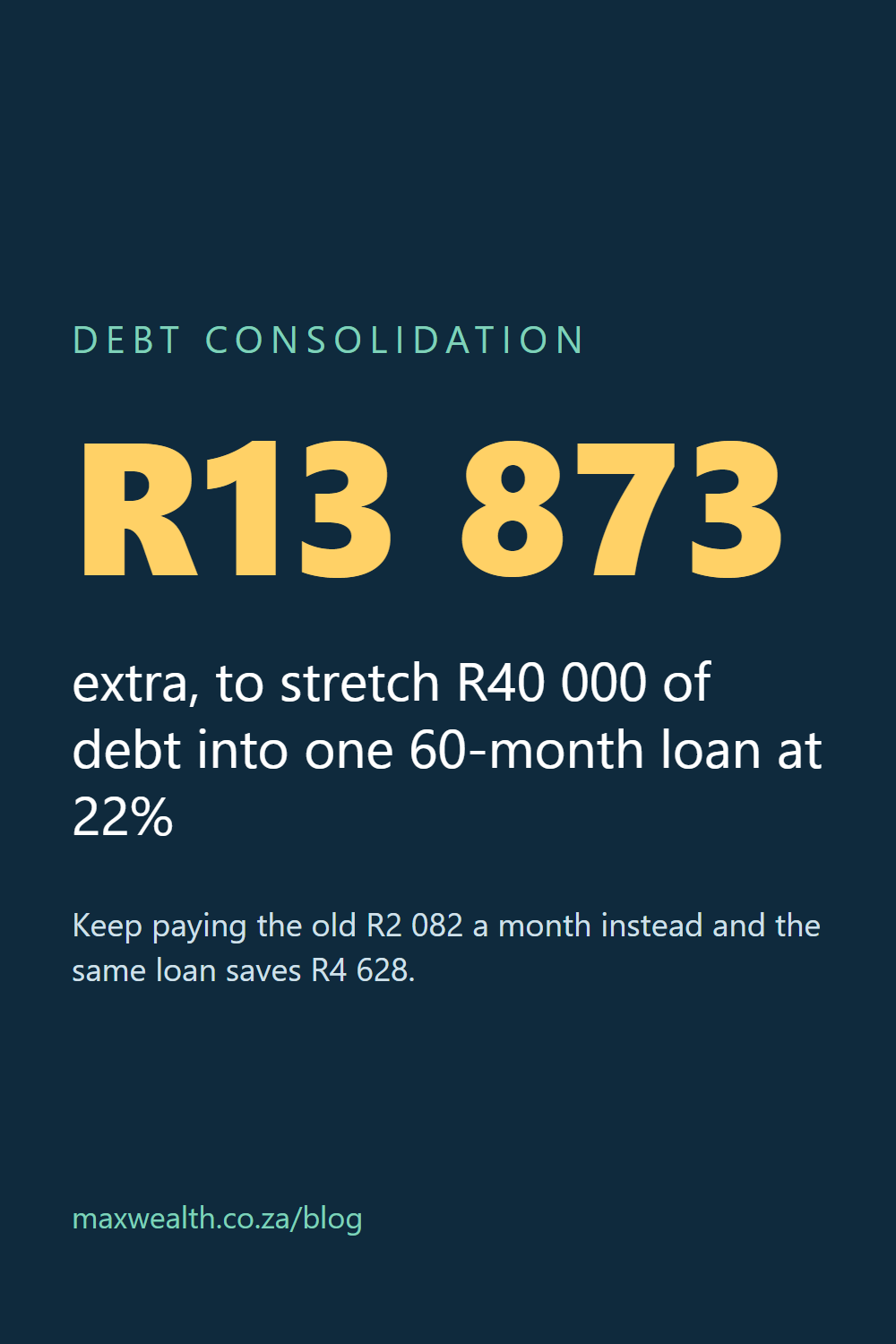
Rolling R40 000 of card, store-card and loan debt into one 60-month loan cuts the monthly payment by R875 but costs R13 873 more - keep paying the old R2 082 into the new loan and it saves R4 628 instead.

In 30 seconds
- Stretching R40 000 of debt into one 60-month loan at 22% costs R13 873 more - the monthly payment falls by R875, and you pay for that relief.
- The same loan, paid at the old R2 082 a month, clears in 26 months instead of 35 and saves R4 628 - consolidation only wins if the payment does not drop.
- At the legal ceiling of 28.25%, the 60-month version costs R22 942 more than leaving the debts alone.
What consolidation actually does
A debt consolidation loan pays off several debts - typically a credit card, a store card and an older loan - and leaves you with one new loan and one instalment.
That sounds like it should be cheaper. It is not automatically. Three things decide whether it saves you money: the new interest rate, the new term, and what you do with the old accounts. The second one matters most, and it is the one the monthly instalment hides.
Yesterday's post on the true cost of borrowing R20 000 covered the legal ceilings. Here we start from someone who already has three debts.
The household in the example
The ceilings come from Regulation 42 of the National Credit Regulations: the repo rate plus 14 points for credit facilities (cards, store cards, overdrafts) and plus 21 points for unsecured loans. With the repo rate at 7.25%, that is 21.25% and 28.25%.
| Debt | Balance | Rate | Paid a month (incl. R69 fee) | Months left |
|---|---|---|---|---|
| Credit card | R18 000 | 21.25% | R769 | 35 |
| Store card | R7 000 | 21.25% | R419 | 25 |
| Personal loan | R15 000 | 28.25% | R894 | 24 |
| Total | R40 000 | R2 082 |
Left alone, and paid exactly like this, all three are gone in 35 months, and the household pays R58 553 in total - R12 757 of that is interest and the rest is capital and fees. The payment also falls on its own: after month 25 only the credit card is left, at R769 a month.
Unverified: the R69 monthly service fee (R60 plus VAT) comes from secondary summaries of the regulations, not a primary text we could read. Your own lenders may charge less, and your own rates are on your statements - use those.
Option 1: one loan over 60 months
This is the offer most people see: one loan for R40 000, at a rate between the card and the old loan - say 22% - over five years. The initiation fee is capped at R1 050 plus VAT, which on this amount is reached, so R1 207.50 is added to the balance (Table B of the same regulation).
The new instalment is R1 207 a month, fee included. That is R875 a month less than before, and it is why consolidation feels like relief.
But it runs for 60 months, not 35. Total paid: R72 426 - R13 873 more than leaving the debts alone. The lower rate is real; it is simply outrun by two extra years of interest on the whole balance.
Option 2: the same loan, the same R2 082 a month
Now take the identical loan - R41 207.50 at 22% - but keep paying R2 082 a month, the amount the household was already paying.
It clears in 26 months instead of 35, and the total paid is R53 925 - R4 628 less than doing nothing. Same lender, same rate, same fee. The only difference is that the payment did not drop.
Two things drive the saving: the higher-rate personal loan is now charged at 22% instead of 28.25%, and two of the three R69 monthly fees disappear.
Option 3: consolidating at the ceiling
A consolidation loan is an unsecured loan, so the lender may charge up to 28.25% - more than the two cards it replaces. At that rate:
| Consolidation loan, R41 207.50 | Monthly (incl. fee) | Total paid | vs leaving debts alone |
|---|---|---|---|
| 22% over 24 months | R2 207 | R52 962 | R5 591 less |
| 22% over 36 months | R1 643 | R59 138 | R585 more |
| 22% over 60 months | R1 207 | R72 426 | R13 873 more |
| 28.25% over 24 months | R2 336 | R56 066 | R2 487 less |
| 28.25% over 36 months | R1 779 | R64 046 | R5 493 more |
| 28.25% over 60 months | R1 358 | R81 495 | R22 942 more |
Read down the columns and the pattern is plain: the term moves the total far more than the rate does. Even at the ceiling, a short loan beats the status quo. Even at a good rate, a long one loses.
The trap after the loan pays out
When the consolidation loan settles the credit card and store card, those accounts usually stay open with their full limits. Nothing in the numbers above survives the cards being used again.
If R25 000 of card limit fills back up over the next year, the household now has the 60-month loan and the card debt - roughly double where it started. Ask the lender to close the settled accounts, or close them yourself, before the first new purchase.
When consolidation makes sense
- The new rate is lower than your weighted average rate, not just lower than the worst one. In the example the average is about 23.9%, so a 22% loan is only a small win on rate.
- The term is no longer than your longest current debt. Here, 35 months or less.
- You keep paying the old total, or close to it, and let the loan finish early.
- The old accounts get closed, not just settled.
If the only way to afford the instalments is to stretch them out, the honest problem is cash flow, not interest rates. A National Credit Regulator-registered debt counsellor can restructure repayments under debt review, which is a different process with its own costs and a flag on your credit record while it runs.
How MaxWealth helps
The debt payoff tool takes each debt's balance, rate and monthly payment and shows when you are debt-free and what it costs in interest, paying highest rate first or smallest balance first. Enter your debts as they are, then enter a single debt with a consolidation quote's rate and term, and compare the two interest totals before you sign.
Sources
- National Credit Regulations, Regulation 42 - maximum interest (Table A) and initiation fees (Table B).
- South African Reserve Bank - Monetary Policy Committee statement, September 2026 (repo rate 7.25%).
- National Credit Regulator - debt counselling.
- Monthly service fee of R69: secondary summaries of the regulations (see note above).
- All repayment figures: our own calculation, monthly compounding, fixed monthly payments, R69 a month in fees per account, consolidation balance R40 000 plus a R1 207.50 initiation fee. The 22% consolidation rate is an illustration, not a quote.
Education, not financial advice. This post explains how the rules and the arithmetic work. It does not recommend any financial product, and your own situation may differ - speak to a registered financial adviser or tax practitioner before you act. Figures were checked against the linked sources on the date above.