Paid early in December: making one salary last 38 days to January payday
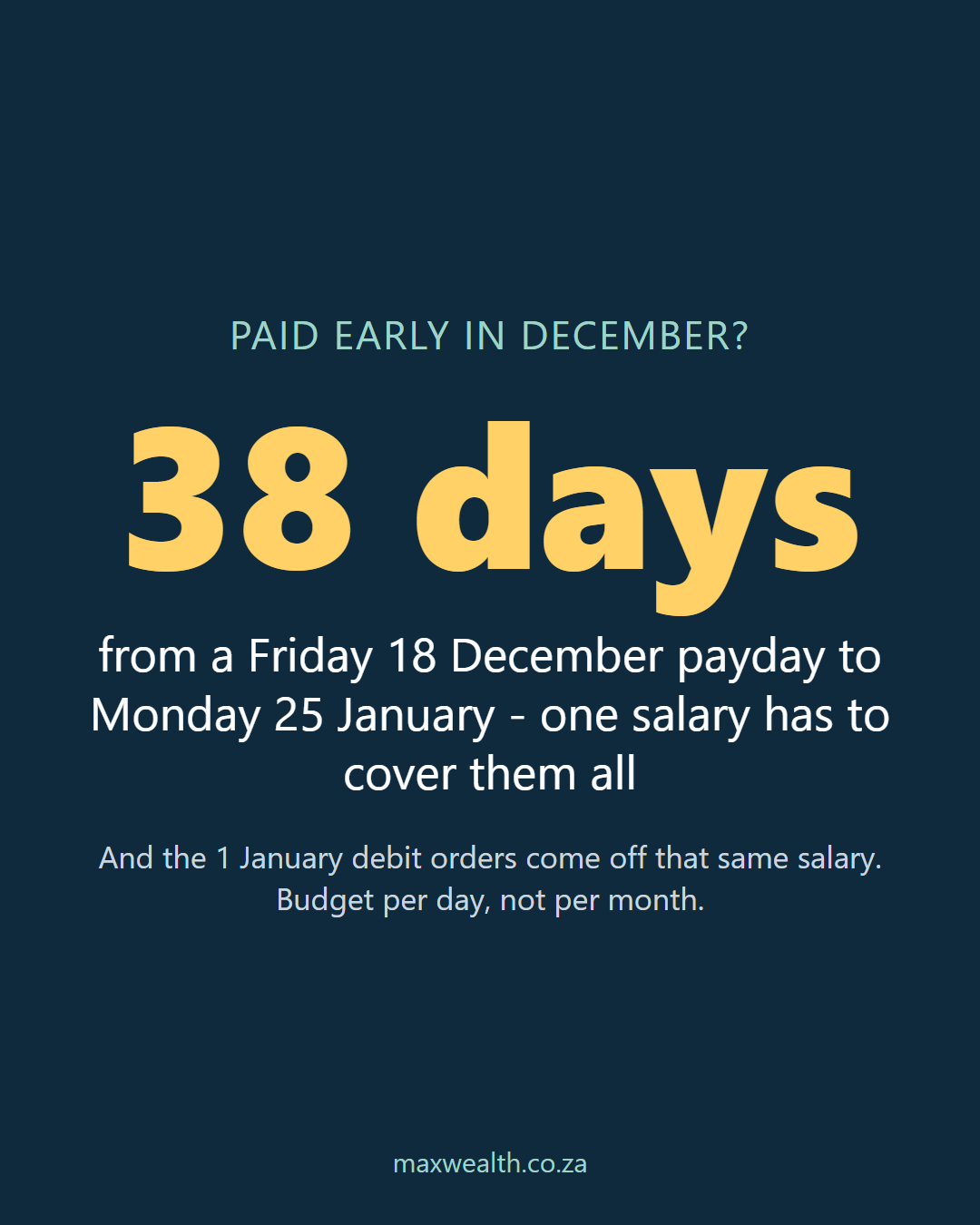
Paid on Friday 18 December and next on Monday 25 January, one salary has to cover 38 days and the 1 January debit orders - in our example the daily budget drops from R283 to R224 unless you carry the slack from the short 23-day stretch before it.

In 30 seconds
- A Friday 18 December payday to a Monday 25 January payday is 38 days - about a week longer than a normal pay month.
- In our example the daily budget falls from R283 to R224 once the 1 January debit orders come off the same December salary.
- Carry the slack from the short 23-day stretch before it and the daily budget across both stretches settles at about R279.
Many employers pay December salaries early so that staff have money before the office closes and the holidays start. It feels like a bonus. It is not - it is the same salary, and it has to last longer than any other pay of the year.
Why the stretch is longer this year
The calendar does most of the damage. In 2026 Christmas Day, the usual payday for many people, falls on a Friday. The Day of Goodwill on 26 December is a Saturday, and New Year's Day on 1 January 2027 is a Friday. Under the Public Holidays Act, only a holiday that falls on a Sunday moves to the Monday, so the Saturday holiday is simply lost.
Then the January payday: the 25th of January 2027 is a Monday, and some employers pay on the last working day instead, which is Friday 29 January.
Count the days from the December payday to the January one:
- Paid Thursday 24 December (the day before Christmas), next pay 25 January: 32 days.
- Paid Friday 18 December, before the office closes: 38 days.
- Paid Tuesday 15 December, the day before the 16 December holiday: 41 days.
A normal pay month is about 30 days. So an early December salary may have to cover a month and a third.
The law only sets the outer limit: the Basic Conditions of Employment Act (section 32) requires pay at least monthly and no later than seven days after the period it is for. It does not stop an employer paying early, so check your own December payday on your payslip or with payroll now, rather than guess.
The part people forget: January's debit orders
Most fixed costs go off at the start of the month - rent or bond, car instalment, insurance, medical aid, phone contract, school fees. In a normal month they come off the salary paid a few days earlier.
In December that same rule bites harder. The debit orders that run on or around 1 January come off the December salary, which was paid two weeks earlier. Nothing new arrives to cover them until late January.
When a debit order date falls on a weekend or a public holiday (1 January 2027 is both a Friday and a holiday), it may run on the business day before or after, depending on the mandate and the bank. We could not confirm one rule that applies to every debit order - check the dates on your own statement from last January.
A worked example
Take a household with R18 000 take-home pay and R9 500 of debit orders and fixed payments that go off at the start of each month. That leaves R8 500 for food, transport, airtime and everything else.
- A normal 30-day month: R8 500 / 30 = about R283 a day.
- Paid 18 December, next pay 25 January: the R9 500 of 1 January debit orders still comes off, leaving R8 500 for 38 days = about R224 a day. That is about R59 a day less, for five and a half weeks, over the most expensive time of the year.
Now look at the other side. November's salary, paid on 25 November, only has to last 23 days to 18 December. Its R8 500 (after the 1 December debit orders) is the same amount spread over far fewer days.
- Spend at your normal R283 a day for those 23 days and you use about R6 509.
- That leaves about R1 991 to carry over, untouched, into the long stretch.
- R8 500 + R1 991 = R10 491 over 38 days = about R276 a day - close to normal.
Put another way: from 25 November to 25 January is 61 days and two salaries, R17 000 to spend after debit orders. That is about R279 a day across the whole period. The trouble only starts when the short stretch is spent as if it were a full month.
Four things to do before 18 December
- Find your two paydays. Write down the December pay date and the January pay date, and count the days between them.
- List the debit orders that run between them. Take the January ones off the December salary the day it lands - move that amount to a separate account or pocket if your bank allows it, so it cannot be spent by accident.
- Work out a daily number, not a monthly one. What is left, divided by the days to the next payday. Thirty-eight days is easier to manage at R224 a day than as "a month and a bit".
- Protect the November slack. Whatever is left of the November salary on 17 December is not spare money; it is the first week of January.
If it still does not fit
If the daily number is too low to live on, the fix is in the fixed costs, not in a loan for the gap. A debit order you no longer use is money back every month, including this long one. And if your employer offers a choice, some people prefer to be paid on the normal date in December: less money for the holidays, but a shorter gap to January.
Bonuses and 13th cheques change the picture, but only if they are kept apart. If one is coming, decide what it is for before it lands, rather than letting it quietly cover the long stretch.
How MaxWealth helps
Debit Watch lists the debit orders that come off your account each month, so you can add up exactly what will go off in early January before the December salary arrives, and see which ones are worth cancelling before the long stretch starts.
Sources
- Public Holidays Act 36 of 1994 - fixed public holiday dates and the rule that a Sunday holiday moves to the Monday.
- Basic Conditions of Employment Act 75 of 1997, section 32 - payment of remuneration.
- Weekdays for each date: the 2026 and 2027 calendars.
- All rand figures: our own illustration (R18 000 take-home pay, R9 500 of start-of-month debit orders), not an average household.
Education, not financial advice. This post explains how the rules and the arithmetic work. It does not recommend any financial product, and your own situation may differ - speak to a registered financial adviser or tax practitioner before you act. Figures were checked against the linked sources on the date above.