Going away for the holidays: what switching the geyser off actually saves
Switching a 150 L electric geyser off for a two-week holiday saves about R65 at Eskom's 2026/27 Homepower rate of R3.56 a kWh - modest, but the same standing loss costs about R2 339 a year while you are at home.

In 30 seconds
- Switching a 150 L geyser off for 14 days saves about R65 - 18 kWh at Eskom's 2026/27 Homepower rate of R3.56 a kWh, after paying to reheat the tank.
- Reheating a cold 150 L tank costs about R25 (7 kWh) - less than the heat a hot tank loses in four days, so switching off never costs you more.
- The same standing loss costs about R2 339 a year while you are at home - the holiday is the small win; the other 50 weeks are where the money is.
The question every December
Before a holiday, someone in the house always asks whether to switch the geyser off at the board. Someone else always answers that heating it up again "uses more than you save".
Both have a point, but only one is right. A geyser that is switched off always uses less electricity than one left on - the only question is how much less, and whether it is worth the walk to the distribution board.
Here is the arithmetic for a typical 150 L electric geyser, using this year's tariff.
Where a geyser's electricity goes when nobody is home
An electric geyser uses electricity for two things: heating the water you draw, and replacing the heat that leaks out of the tank all day. The second is called standing loss, and it carries on whether anyone is home or not.
While you are away, nobody draws hot water. So everything a geyser left on uses in those weeks is standing loss - electricity spent keeping water hot for nobody.
Our geyser calculator uses 1.8 kWh a day of standing loss for a 150 L tank (0.012 kWh a litre a day). That is our working estimate, not a measured figure for your geyser: older tanks, tanks in a cold roof space and tanks with a higher thermostat setting lose more.
Unverified: the national standard for electric geysers (SANS 151) is reported to allow up to 2.5 kWh a day of standing loss for a 150 L tank. We could only find this in secondary summaries, not the standard itself, so the table below shows both 1.8 and 2.5 kWh a day.
What a unit of electricity costs this year
Eskom's tariffs for 1 April 2026 to 31 March 2027 put the Homepower energy charge at 322.06c a kWh including VAT, plus an ancillary service charge of 0.52c and a network demand charge of 32.98c, both per kWh. Together that is 355.56c, or about R3.56, for every extra kWh (Eskom 2026/27 tariffs).
On the prepaid Homelight 20A tariff the rate is 270.30c a kWh including VAT - about R2.70.
Most households buy from a municipality, not from Eskom directly, and municipal rates differ. Use the rate on your own bill or token slip if you know it; the kWh figures below do not change, only the Rand.
The cost of reheating a cold tank
The "it uses more to reheat" argument comes from the burst of electricity a geyser uses when you switch it back on. That burst is real, and it has a ceiling.
Heating water takes 4.186 kJ per litre per degree. Eskom's own residential calculator assumes mains water arrives at about 20 °C. Taking a full 150 L tank from 20 °C to 60 °C:
150 L x 4.186 kJ x 40 °C = 25 116 kJ, or about 6.98 kWh - roughly R25 at R3.56 a kWh.
That is the most a reheat can cost, because the tank can never cool below the temperature of the room it is in. And it is less than the 7.2 kWh a hot tank loses in four days at 1.8 kWh a day.
There is a second reason switching off always wins. A tank loses heat faster the hotter it is. A tank cooling down loses less each day than one held at 60 °C, so the heat it loses while you are away - which is exactly what the reheat replaces - is always less than the standing loss it would have run up if left on.
What it saves, trip by trip
The table takes the cautious view: it assumes the tank cools all the way down while you are away, so the full 6.98 kWh reheat comes off the saving.
| Away for | Saved at 1.8 kWh a day | At R3.56 | Saved at 2.5 kWh a day | At R3.56 |
|---|---|---|---|---|
| A weekend | Close to nothing | A few rand | Close to nothing | A few rand |
| 7 days | 5.62 kWh | R20 | 10.52 kWh | R37 |
| 14 days | 18.22 kWh | R65 | 28.02 kWh | R100 |
| 21 days | 30.82 kWh | R110 | 45.52 kWh | R162 |
On the Homelight 20A rate of R2.70, the 14-day saving at 1.8 kWh a day is about R49.
So the honest answer is: switching off for a two-week holiday saves roughly the price of a takeaway meal. It is worth doing because it costs nothing, but it will not rescue a January budget on its own.
The bigger number: the other 50 weeks
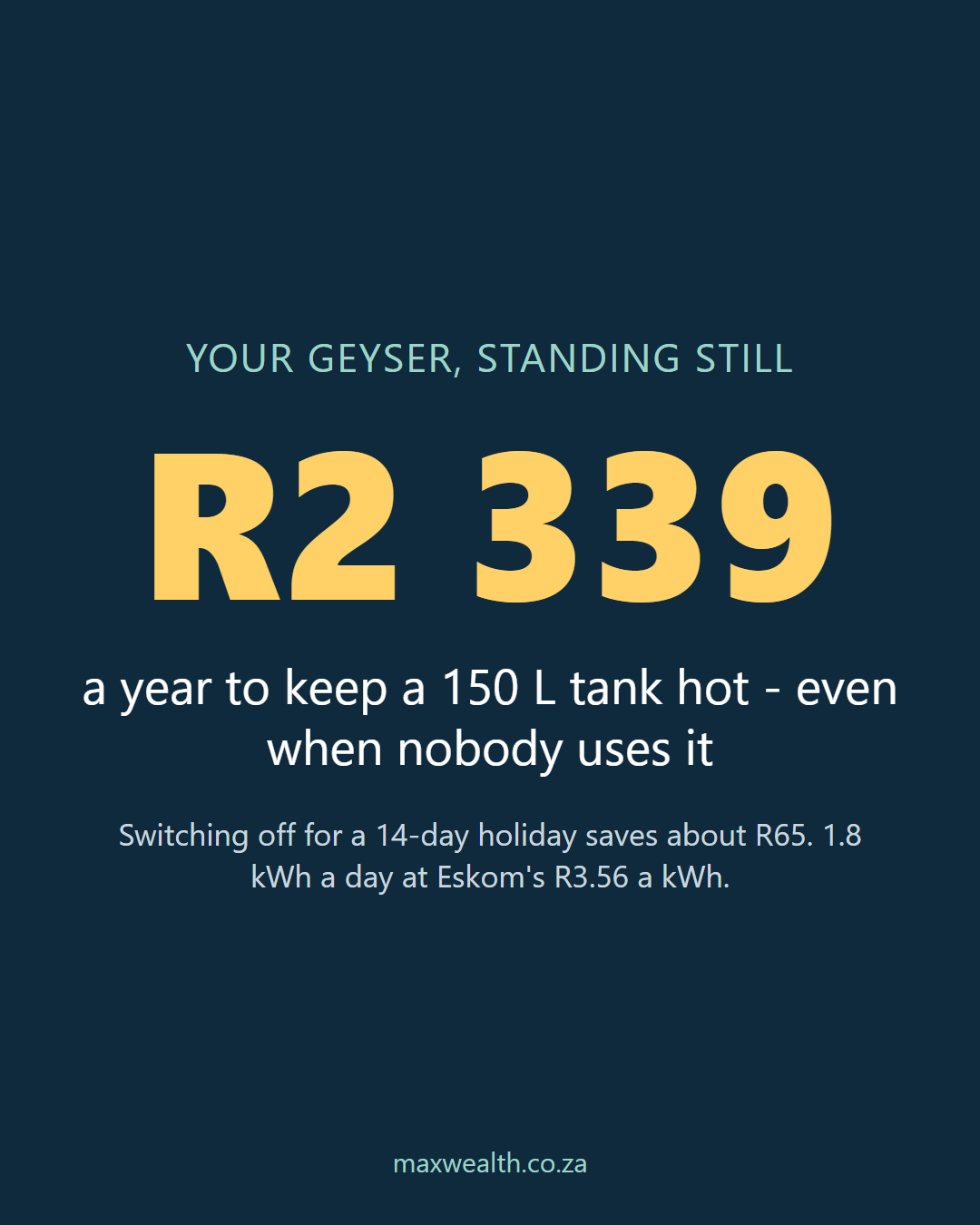
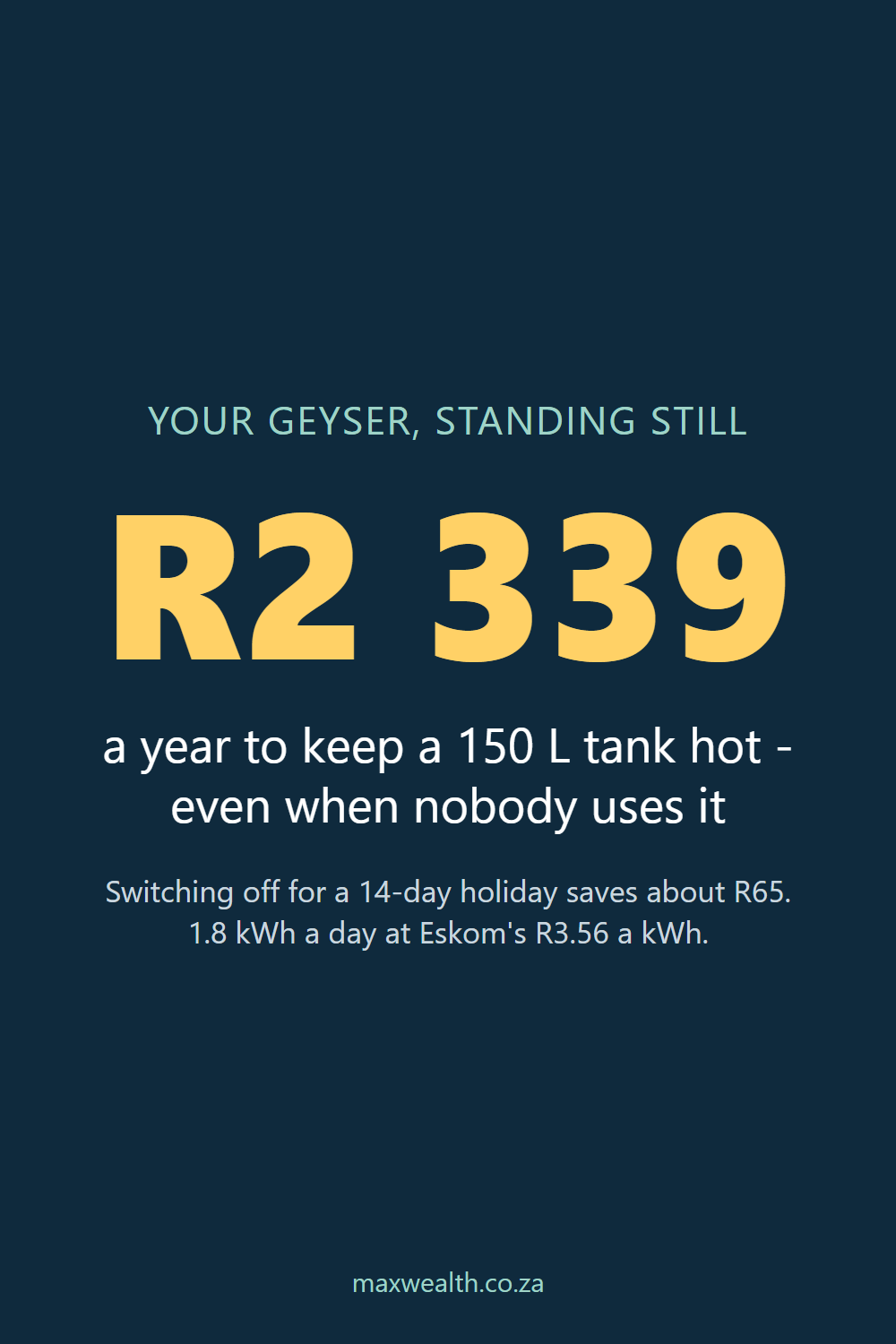
The same standing loss runs every day of the year. At 1.8 kWh a day that is 657 kWh a year - about R2 339 at R3.56 a kWh. At 2.5 kWh a day it is 912.5 kWh, or about R3 249.
That is the figure worth working on, and the holiday sum is a useful way to see it: if 14 days of standing loss is worth R65 to you, a year of it is worth more than thirty-five times as much.
What moves that number is mostly physical: how well the tank and the first few metres of pipe are insulated, where the tank sits, and the thermostat setting. Our geyser calculator also shows how a heat pump or a solar geyser compares, if your geyser is due for replacement anyway.
Do not turn the thermostat down to save more
It is tempting to set the thermostat low and keep it there. The World Health Organization's fact sheet on Legionella says the bacteria grow in water at 20 to 50 °C, and recommends keeping hot water above 50 °C, which means water leaving the heater at 60 °C or more.
The same applies when you get home. The water in a switched-off tank has spent days in that growth range, so let the geyser reach its full temperature before the first shower.
Before you leave, and when you get back
- Switch off at the geyser's own breaker on the distribution board, not the main switch, so the fridge and alarm stay on.
- Switch back on a few hours before you need hot water. A 6.98 kWh reheat through a 3 kW element takes about 2 hours and 20 minutes; check the rating plate for your element's size.
- If you also close the water supply to the geyser, open it again before you switch the electricity on, so the element is never heating an empty or isolated tank.
- On rooftop solar, a geyser that heats from daytime panel output costs you less per kWh than the table shows, so the Rand saving is smaller.
How MaxWealth helps
The geyser calculator works out what your electric geyser uses each month from your tank size, hot water use and tariff, including the heat the tank loses standing, and shows the year a heat pump or solar geyser would pay back its install cost. Put in your own tariff from your bill to see what your standing loss costs a year.
Sources
- Eskom - 2026/2027 tariffs, effective 1 April 2026, and the tariff workbook: Homepower (non-local authority) energy charge 322.06c, ancillary service charge 0.52c and network demand charge 32.98c a kWh; Homelight 20A 270.30c a kWh; all including VAT.
- Eskom residential calculator - assumptions (mains water at about 20 °C).
- World Health Organization - Legionellosis fact sheet (growth at 20-50 °C, water leaving the heater at 60 °C or more).
- Standing loss of 1.8 kWh a day for 150 L: MaxWealth's working estimate (0.012 kWh a litre a day), as used in our geyser calculator. SANS 151 limit of 2.5 kWh a day: secondary summaries only (see note above).
- All savings figures: our own calculation. Heat capacity of water 4.186 kJ a litre a degree, 20 °C to 60 °C, full reheat of 6.98 kWh deducted from every trip, 3 kW element for the reheat time.
Education, not financial advice. This post explains how the rules and the arithmetic work. It does not recommend any financial product, and your own situation may differ - speak to a registered financial adviser or tax practitioner before you act. Figures were checked against the linked sources on the date above.