A budget smartphone: what spec you actually need, and why cash beats a 36-month contract
A new phone with 4GB RAM and 128GB storage costs R2 400 to R4 500 this week, while a R579-a-month contract runs to R20 844 over 36 months - check the total before you sign.
In 30 seconds
- 4GB RAM and 128GB storage is the floor - that spec costs about R2 400 to R4 500 new this week, and it runs WhatsApp, banking apps and a camera comfortably.
- A R579-a-month contract is R20 844 over 36 months - add up the whole term before you compare it with a cash price.
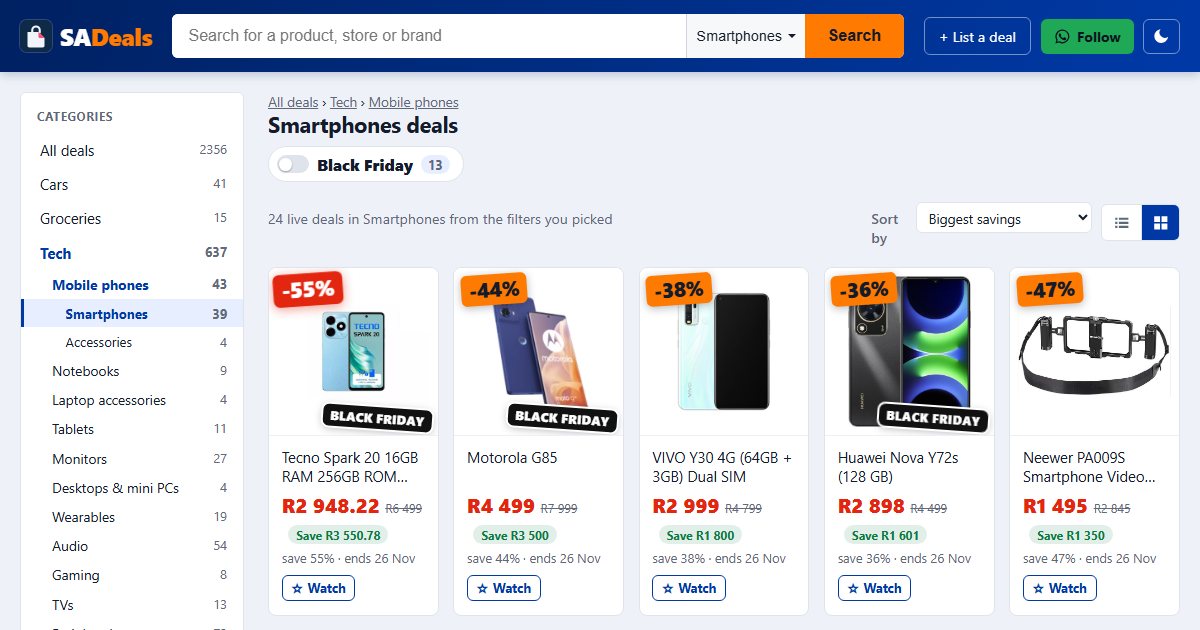
- "55% off" on a R2 948 phone means a R6 499 was-price - check that the old price was ever real before the discount sways you.
What a phone for everyday use needs
If the phone is for WhatsApp, email, banking apps, maps and photos of the kids, you do not need a flagship. You need enough memory that it does not stall, and enough storage that it does not fill up in six months.
- RAM: 4GB minimum. Phones with 3GB are still sold, and they are the ones that slow down when a few apps are open at once.
- Storage: 128GB. 64GB sounds like a lot until WhatsApp photos and voice notes fill it. A phone that is always "storage full" is the most common reason people replace a working phone.
- 4G is fine. 5G is nice to have, but on a budget it is the first thing to give up - most everyday use works the same on 4G.
- Software updates matter more than the camera count. A phone that stops getting security updates becomes a risk for banking apps. Check how many years of updates the maker promises before you buy.
- Check that it runs the apps you need. Some phones sold locally do not come with Google Play. If your bank's app or your work tools are only on Google Play, make sure the phone has it.
Filter for that spec, not for the shop
On sadeals.co.za, open Tech > Mobile phones > Smartphones, tick New, set a price range, then use the RAM and Storage filters on the left. Phones that miss the floor drop out before you get attached to one.
Prices we saw on 19 November 2026, all new, with the retailer's own was-price:
- Under R2 000 - a 64GB phone at R1 799 (was R2 299). Cheap, but below the 128GB floor.
- R2 400 to R3 000 - a 128GB phone with 8GB RAM at R2 389 (was R3 299), and a 128GB phone at R2 898 (was R4 499).
- R3 900 to R4 500 - mainstream 128GB models at R3 899 (was R4 299) and R4 499 (was R4 999).
None of these is a recommendation - they show that the everyday spec costs R2 400 to R4 500, not R10 000.
Add up the contract before you sign
A contract hides the price of the phone inside a monthly number. The only fair comparison is the total over the whole term:
- R579 a month for 36 months is R20 844. That was the advertised contract price for a current-generation iPhone this week.
- A R3 899 phone plus R150 a month of prepaid data and airtime for 36 months is R9 299 - less than half, for a phone that does the same everyday jobs.
- The contract does include airtime and data, so compare it with what you really spend on prepaid, not with zero.
R150 a month is an example prepaid spend for the arithmetic, not a quoted bundle price - use your own monthly spend.
A contract is also a fixed debit order for three years. If money gets tight in year two, the phone you are still paying for cannot be cut back the way a prepaid top-up can.
Check the was-price
The biggest discount on the same page was 55% off: a phone at R2 948, "was R6 499". Maybe it really sold at R6 499. But a R3 551 saving is a reason to check, not a reason to buy:
- Does the spec match the old price? If similar phones sell for R3 000 elsewhere, the was-price is decoration.
- Is it on your list and inside your budget? If not, the percentage does not matter. Our Black Friday guide covers how to test a was-price.
How MaxWealth helps
A phone contract is one more debit order that runs for years. Debit Watch helps you keep track of the debit orders going off your account, so you can see what a new contract adds before you sign, and spot the old ones you no longer use.
Sources
- sadeals.co.za smartphones, new, R1 000 to R5 000 - prices, was-prices and end dates as displayed on 19 November 2026.
- sadeals.co.za smartphone search - 36-month contract price as displayed on 19 November 2026.
- Contract and prepaid totals: our own arithmetic - monthly amount multiplied by 36 months, plus the cash price for the prepaid example.
Education, not financial advice. This post explains how the rules and the arithmetic work. It does not recommend any financial product, and your own situation may differ - speak to a registered financial adviser or tax practitioner before you act. Figures were checked against the linked sources on the date above.